IoT HealthTech: Digitizing Pain Management with a Squeeze-to-Record Ecosystem
This project sits at the intersection of digital health + connected hardware + real-world clinical constraints. Grasp uses a handheld IoT device as the primary input method. Patients log events by squeezing the device, and the software turns that physical interaction into structured symptom history over time.
I designed key parts of the product across mobile, web, and iPad, collaborating with a Norway-based UX team that conducted clinician interviews and collected pilot insights from participating clinics. My job was to translate real research outputs into shippable UI and interaction design—especially for the symptom tracker and medication tracking workflows that users would repeat daily.
Project summary
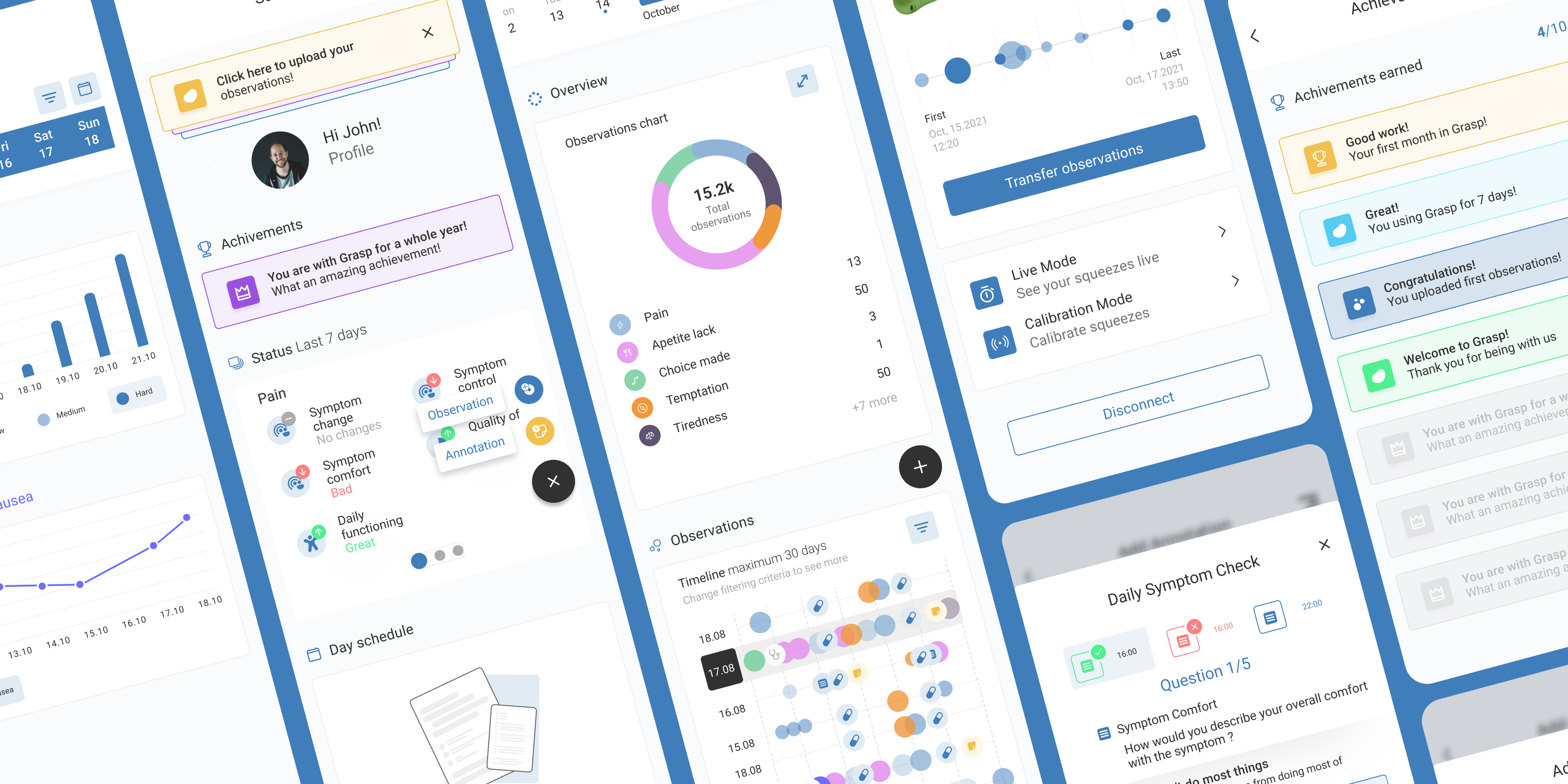
A few municipality app examples built on the same core product, each with its own look and module setup.
Overview
Grasp is a Norwegian digital health product built around a simple but unusual idea: patients log symptoms by squeezing an IoT device, and the app turns that physical input into structured data over time. Instead of asking users to constantly type, rate, and explain everything in words, Grasp makes symptom tracking fast, discreet, and repeatable even in moments when people don’t have energy for long forms.
The system supports logging a wide range of experiences such as pain, stress, anxiety, shortness of breath, dizziness, hunger, withdrawal, but also positive states like motivation and happiness. A squeeze can capture not just that something happened, but also how intense it was and how long it lasted. Over time, these “events” build a timeline that can be reviewed as daily summaries, trends, and category breakdowns, making the data useful not only to the patient but also in clinical conversations.
The product was developed and validated in a real pilot with Norwegian clinics, with access to interviews and real-world usage patterns gathered by a local UX team working with clinicians and medical stakeholders. My role was to translate those insights into concrete product design decisions across platforms. I designed key parts of the experience for mobile, web, and iPad, focusing mainly on the symptom tracker and medication tracking, plus the surrounding flows that make the whole thing work in real life: onboarding, device connection, calibration, daily assessments, and insight views.
The problem: flaws of retrospective pain tracking
Traditional pain management relies heavily on memory and paper. During short clinic visits, doctors ask patients to rate their pain retroactively using paper ESAS-R forms (on a scale of 0 to 10). This process is fundamentally flawed.
Subjective and inaccurate
Patients rarely remember exactly how they felt three days ago at 2:00 PM. Memory distorts pain ratings in both directions.
High cognitive load
Paperwork overwhelms both the patient and the medical staff — time that should be spent on care is spent on forms.
Lack of actionable data
Doctors make critical diagnostic and medication decisions based on fragmented, retrospective interviews rather than continuous data.
Opportunity
What if patients could log symptoms in the moment, with almost no friction — and doctors could read that data as clear, actionable insights?
Hardware meets software
The solution centered around an IoT device patients carry with them. When they feel a symptom, they squeeze it — the tighter the grip, the higher the recorded intensity. To bring this hardware to life, I designed a dual-platform digital ecosystem.
Mobile App
For patients
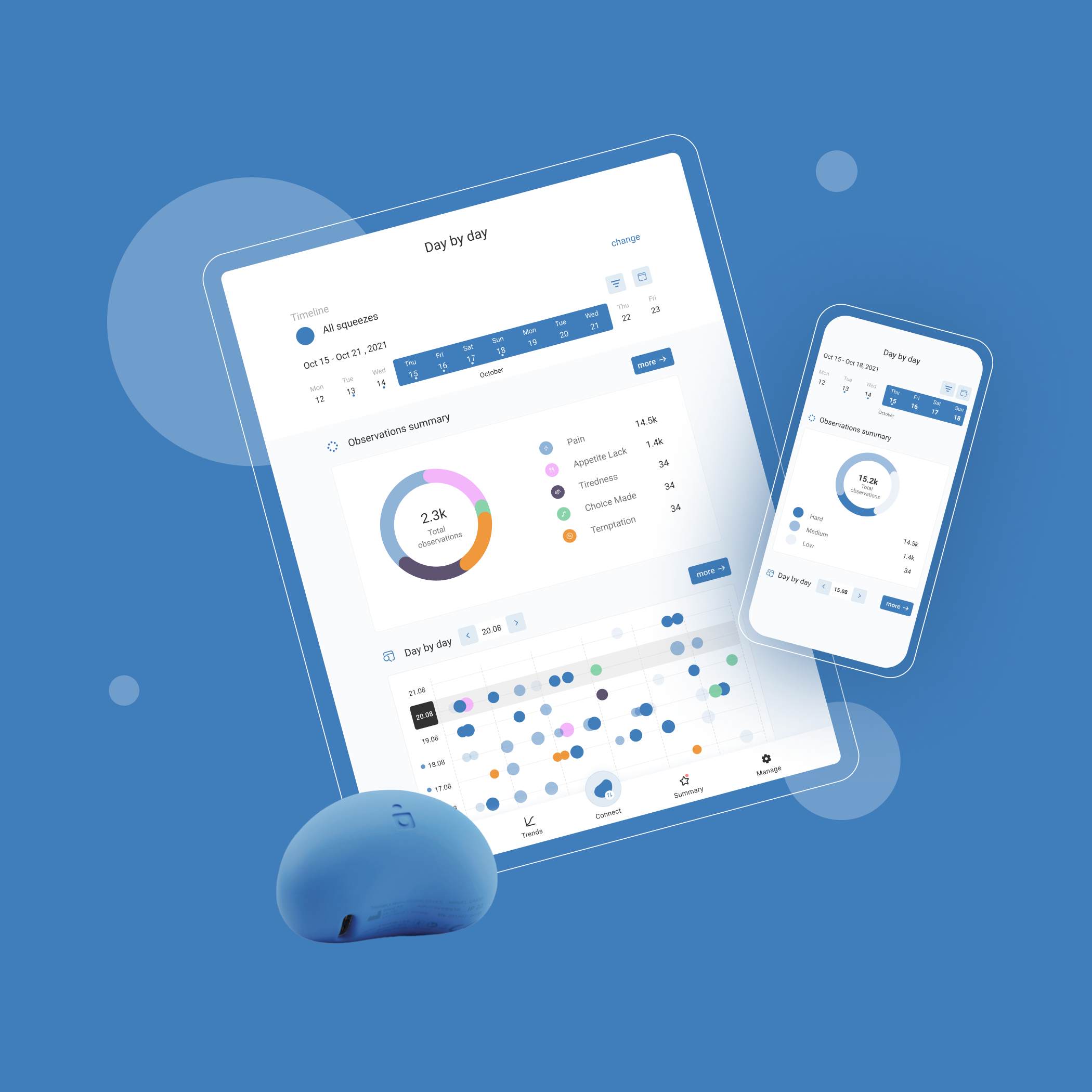
A companion app focused on seamless IoT device pairing via Bluetooth. Patients can download hardware data, view pain timelines, log manual notes, and answer daily medical questionnaires. It acts as a digital, automated health diary.
Web App
For clinics & doctors
A complex management dashboard allowing medical staff to assign devices, manage patient cases, and view incoming data translated into clear, actionable charts and timelines — monitoring drug effectiveness and symptom trends.
Core challenges & UX breakthroughs
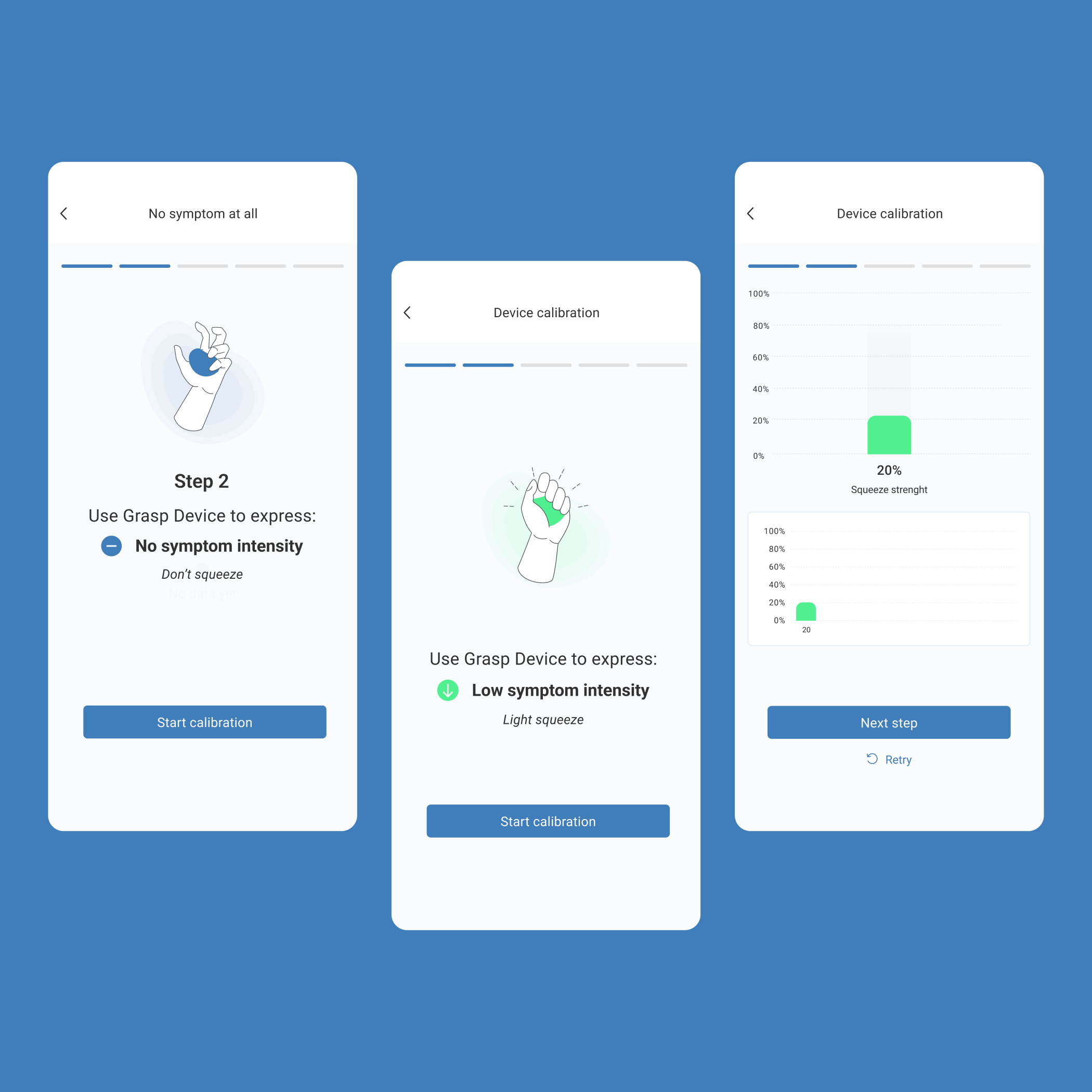
The calibration of subjectivity
The calibration flow I designed guides each user through a short, intuitive setup session during onboarding. The device learns the individual's grip range: their resting baseline, their comfortable midpoint, and their maximum squeeze. From that point on, every recorded symptom is measured against their personal scale, not a universal one.
The challenge was making this feel approachable and trustworthy — not clinical or intimidating. Patients needed to feel confident the device "understood" them before they would rely on it day to day. I used clear animated feedback, plain-language instructions, and a step-by-step structure that let users redo any step if something felt off. Getting calibration right was non-negotiable: it was the foundation everything else was built on.
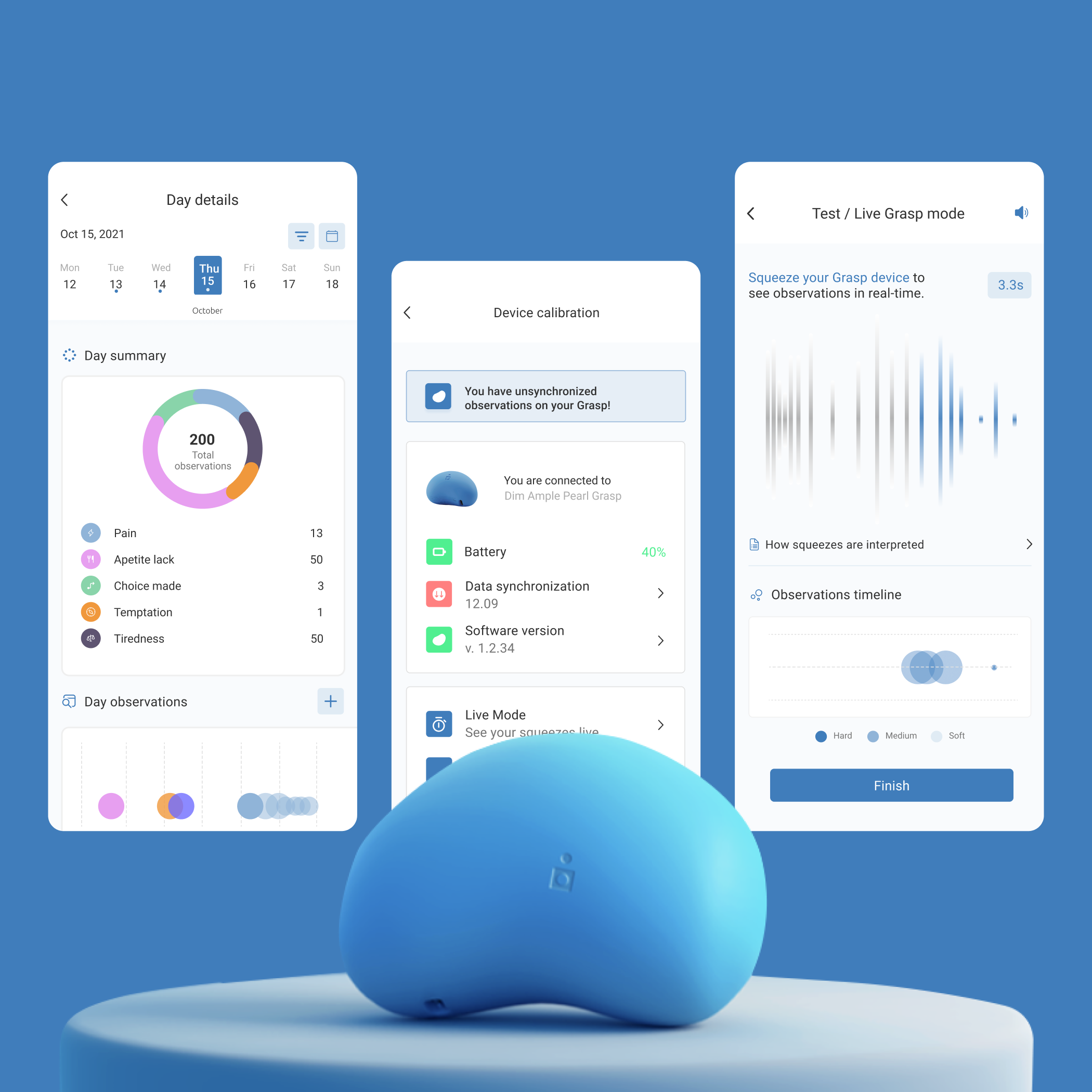
Translating squeezes into medical UI
Designing for the "unhappy paths" in IoT
Strict medical compliance
Deliverables
- End-to-end symptom tracker UX across mobile, web, and tablet — covering daily logging, timeline views, and medical questionnaires
- IoT device pairing, calibration, and data sync flows (including all error and recovery states)
- Medication tracking module with reminders, dosage logging, and visual adherence history
- Clinical dashboard with time-series data visualizations for monitoring pain trends and medication effectiveness
- Design system spanning iOS, Android, and Web to enable consistent, fast implementation across platforms
- Onboarding flows aligned with FDA and MDR requirements — vetted for medical device compliance
What I learned
- IoT requires extreme edge-case mapping. Designing for physical devices means anticipating hardware limitations — you are not just designing UI, you are designing the bridge between human action, sensor data, and digital interpretation.
- The weight of product ownership in HealthTech. Collaboration with doctors, investors, and clinics made clear that building medical tools is not just a business opportunity — it is a responsibility to handle sensitive data securely and build things that genuinely improve human lives.
- Compliance is a design constraint, not an afterthought. FDA and MDR requirements shaped decisions from the very beginning. Learning to design within regulatory frameworks made every solution more considered.
- Agile in a hardware-software environment means constant recalibration. As the physical device evolved, the UI had to pivot quickly — I learned to treat hardware changes as design input, not disruption.
See also
Other projects you might find interesting
Turning a complex loyalty platform into something people actually enjoy using
Scaling one waste management product into multiple municipality-branded apps.
AI-Powered Social Media Reputation Guard: Scan, Detect, Protect
🍪 This site uses cookies
I use Hotjar and Google Analytics to understand how people use this portfolio. No data is sold or shared with third parties beyond these tools.